Growing a Leader

Published on 26 May 2026
You might look at Dr. Carol Huston’s career and assume she has always been comfortable in a leadership role. As Sigma’s
2025 Mary Tolle Wright Founders Award for Excellence in Leadership recipient, past Sigma president, and author of hundreds of articles and multiple textbooks, including Leadership Roles and Management Functions in Nursing (the 12th edition released spring 2026), she definitely comes to mind when you think of a nurse leader.
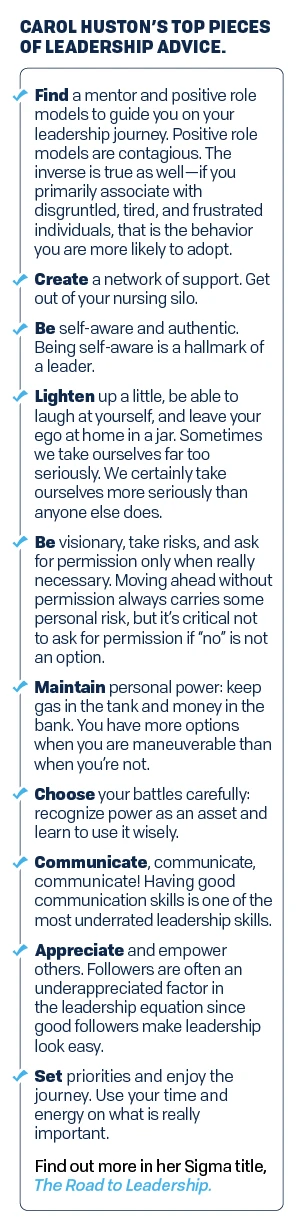
Leaders are those individuals in the front who move forward, take risks, and challenge the status quo to make things better. Huston didn’t set out to be a leader, but she always knew she wanted to make a difference and was willing to work hard to do so. “I was more of a quiet leader when I was young, with a fair degree of humility and an enormous fear of public speaking,” Huston remembers. “Even at a very young age, though, I was a risk taker and problem solver. I was also innovative and goal-oriented, worked hard, and communicated well.”
Throughout her life, Huston began to understand that it wasn’t always the loudest voice in the room that had the most leadership skills. “Not all leaders are gregarious by nature,” she notes. “Many of the most effective leaders I’ve encountered didn’t set out to hold leadership positions; instead, they became leaders by taking initiative in situations where others hesitated or faltered. They simply stepped in to do what needed to be done.”
In fact, Huston listened to and leveraged the mentorship of skilled leaders to advance her nursing journey. “Their advice and guidance made me a better person and a stronger leader. They also inspired me to stretch and become more than I thought possible,” Huston says. “Having someone really believe in you and be your cheerleader is a tremendous gift. My mentors stimulated self-discovery, role modeled how to teach, and encouraged me to return to school, to publish, and to pursue leadership opportunities.”
One of the ways Huston has given back to the field as a legacy nursing leader is by helping nurses develop the skills and self-confidence they need on their own leadership journeys. Citing what she calls a “crisis of confidence,” Huston says she often encounters nurses who are ready to lead, but unsure of their abilities. In fact, one constant she has heard from nurses globally is that many feel their leadership skills are inadequate, even for roles they already hold. Indeed, there is a significant degree of imposter syndrome in nursing leadership.
Huston suggests several factors negatively affect nurses’ confidence levels in leadership development. “In some cases, it’s because nurses have had inadequate formal education or training in leadership and management. Some had that training but didn’t really listen because they didn’t think it would pertain to them. Others listened but were still unprepared for how quickly they were expected to assume leadership positions as new nurses.” In addition, the road to leadership is often more difficult than we acknowledge. Huston suggests, however, that most nurses probably have far better leadership skills than they realize, but far too often, they have to learn these skills the hard way, by trial and error. The personal and professional consequences of doing so can be significant.
For nurses, Huston notes that leadership skills are now an expectation, even for novice nurses. “I personally believe every nurse should be a leader, and indeed, leadership is an expected 21st-century competency for all nurses. Leadership, though, is not about having a title or position of authority. It’s about believing in others, caring, and having a desire to serve,” Huston says. “Leadership is not about you, your ego, or your wants. It’s about making things better and solving problems others are facing in their lives.”
Huston believes that her leadership journey has been helped by her willingness to be human—to make mistakes and to change one’s mind—which is evidence of critical thinking and being open to redefining how you look at problems and situations. “I have made mistakes on my leadership journey. I used to put this crazy pressure on myself to excel at almost everything,” Huston says. “I now give myself permission to be less than perfect, especially if it’s not a high-quality decision or task! Sometimes it just has to be “good enough” and for me … that difference between having to be perfect all the time and just being good enough has made such a difference in my life.”
When it comes to empowering nurses in their own leadership journey, Huston offers a vision for how to fully engage with being a leader: “It can be scary as a new leader when followers expect you to not only have the skills to solve the problems of today as well as to be visionary in predicting the problems yet to come and proactively develop solutions to those problems,” says Huston. “Just remember that you don’t have to have a perfectly polished crystal ball. You just have to pay attention to how the world is changing around you and be open to what people need and want, and then be truly innovative in considering new ways to make that happen. Intentionality, caring, and authenticity are truly the keys to success as a leader.”
SPONSORED CONTENT
Deep Dive
Topic
Leadership
Story Type
Stories
Deep Dive
Topic
Leadership
Story Type
Stories
More Stories in Leadership
Discover More Stories
Leadership / Global - Europe
Lead together, right where you are
Published on 8 May 2026
By Liz Westcott
Leadership
Lead before you're ready
Published on 24 March 2026
By Michelle Novominski and Cindy Paradiso

Leadership / North America
From survivor to leader: My journey as a nursing-centered advocate
Published on 18 June 2025
By Ivonne Espinosa