When the planet becomes the patient

Published on 16 April 2026
Imagine being a nurse at a local hospital in a city in the middle of a heatwave. Elderly patients are collapsing in the heat, and student athletes are arriving unconscious in ambulances. Only this isn’t happening in the heart of summer; this heatwave is happening in early spring 10 years from now—in the upper Midwest of the United States, the Hebrides in Scotland, or Seoul, South Korea.
It happened slowly, but the earth is warming, the weather is markedly different, and you are now used to seeing the effects of climate change every day at your hospital. At first, it might have just been the elderly or infirm, but now environmental change is beginning to take a toll on the young and healthy with previously undiagnosed health problems.
What to do about climate change isn’t just a job for environmental scientists, activists, and legislators. Human health has become inextricably tied to planetary health. Nurses are on the front lines of this crisis and need to have the tools to recognize and treat victims of climate change.
A study by the Intergovernmental Panel on Climate Change (IPCC) notes that 3.6 billion people already live in areas highly susceptible to climate change, with that number expected to grow. In these areas, there are fears of more frequent natural disasters, acute heat illnesses, airborne and waterborne diseases, famine and malnutrition, and weakened healthcare infrastructure.
Even more devastating are the effects on vulnerable populations, where a lack of access to safe food and water, or quality healthcare, is causing a major crisis. The strain on resources is expected to cause overwhelmed healthcare centers, particularly when faced with a disaster or pandemic. As world leaders and healthcare organizations struggle to adapt to the day-to-day changes around them, the incremental growth of climate-based illness and injury can best be recognized by healthcare professionals charged with the daily patient care. This means that nurses worldwide are at the forefront of the climate change fight. The impacts of healthcare issues exacerbated by the environment will be seen first in the emergency rooms and triage centers across the globe.
Nurses Are Fighting Back
But hope is still very much alive, and nurses are on the frontlines of making a difference. As those bearing witness to the climate crisis, nurses are the first to see climate change injuries in patients. They must have the most in-depth knowledge to identify what’s happening.
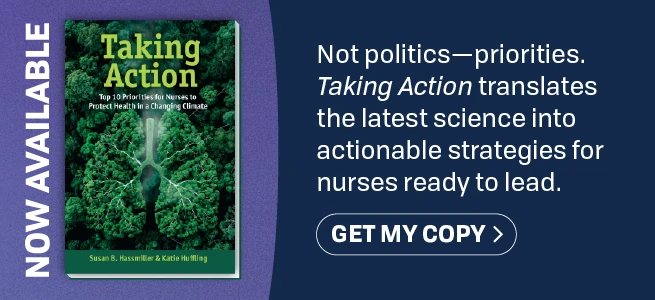
In Taking Action: Top Ten Priorities for Nurses to Protect Health in a Changing Climate, authors Susan B. Hassmiller and Katie Huffling view the crisis with a long lens. They dive deep into the issues affecting nurses as the climate change issue continues to grow. From transforming nursing research and education to creating nursing advocacy groups and driving organizational change, the book translates the latest science into operational strategies. These strategies underpin a massive effort underway to put climate health tools in the hands of the experts who see the impact first–nurses.
Health impacts from climate change—including heat-related morbidity, poor air quality, and wildfire-induced respiratory illness—are just some of the issues facing nurses globally right now. And that’s just the start. As climate change threatens food and water sources, illnesses derived from nutritional deficits can only worsen the problem. Moreover, the aftereffects, such as trauma, life disruptions, and vector-borne diseases, are worsening the quality of life in underdeveloped countries, but have shown signs of affecting first-world nations as well.
Our window to act is quickly closing, and this book is a clarion call to the nursing profession to care for both human and planetary health. However, if nurses are provided with the tools they need to understand and combat the health effects of climate change, we can become stewards of the earth and begin to put in place practices that will have a positive impact on patient outcomes.
Deep Dive
Topic
Global Impact
Story Type
Stories
Global Region
North America
Deep Dive
Topic
Global Impact
Story Type
Stories
Global Region
North America
In This Story
More Stories in Global Impact
Discover More Stories
Global Impact / Global - Oceania
Thinking globally, acting globally
Published on 26 February 2026
By Monina Hernandez

Global Impact / Global - Middle East
P.E.A.C.E. in motion
Published on 7 August 2025
By Maurice Joy Cudal

Global Impact / North America
Lead, but learn where you land
Published on 6 June 2025
By Femi Olutoye